 What It Means to Buy From a Q Grader Certified Coffee Importer
A Q grader certified coffee importer is not the standard in the green coffee trade. Most importers buy and resell without anyone on staff holding formal sensory evaluation credentials. ICT Coffee, a specialty green coffee importer based in San Diego, CA, has Q Grader-certified team members evaluating incoming lots — which means every bag of green coffee they sell has been through a structured, professional quality assessment before it’s offered to roasters in the USA and Canada.
That distinction matters because green coffee quality is not self-evident. A bag labeled “Grade 1 Ethiopia” can cover an enormous range of actual cup quality. The only way to know what’s in the bag is to weigh it, measure it, screen it, and cup it — and to do that well, you need trained people with calibrated palates and the right methodology.
What the Q Grader Certification Actually Requires
The Q Arabica Grader certification is administered by the Coffee Quality Institute (CQI) and requires passing 22 exams across sensory skills, green coffee evaluation, and roasted coffee assessment. These include tests of olfactory discrimination, triangulation cupping, green grading, and the ability to score coffees accurately and consistently on the SCA’s 100-point scale.
The coffee grading certification SCA framework provides the foundation — but the CQI’s exams go well beyond basic familiarity. Candidates must demonstrate calibrated sensory acuity under exam conditions, which is why the pass rate is not trivial. ICT Coffee’s commitment to maintaining Q Grader credentials on staff means their quality standards are tied to an externally validated, repeatable methodology — not just individual taste.
You can read more about what a licensed Q Arabica Grader does and how the certification works in ICT’s own coverage of the topic.
The Green Coffee Evaluation Process at ICT
When a lot arrives at ICT Coffee, it goes through a structured intake evaluation before it’s offered for sale. The green coffee cupping process starts before the first cup is brewed. The physical green evaluation comes first: moisture content is measured using calibrated equipment, because beans outside the 10–12% moisture range are more susceptible to defects and staling. Screen size is checked to assess uniformity, since inconsistent screen sizes can lead to uneven roasting.
Defect counts follow the SCA green grading protocol. Primary defects — full blacks, fulls sours, pods — are counted separately from secondary defects. A green sample that fails the defect threshold doesn’t move forward, regardless of origin or price. This step alone catches problems that would otherwise land in a roaster’s batch mid-production.
Cupping: What ICT Looks For in the Cup
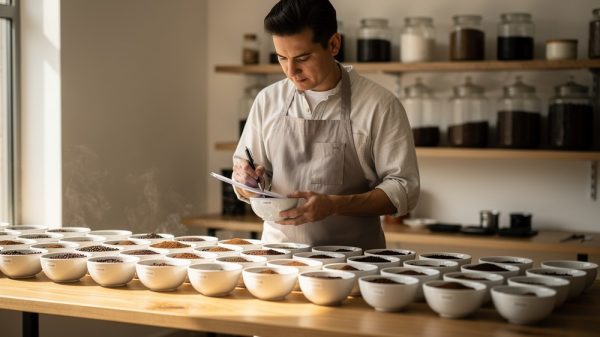
After physical evaluation, the lot is roasted to a medium level and cupped using SCA protocol — 8.25g of coffee per 150ml of water at 200°F. ICT’s Q Graders evaluate dry aroma, wet aroma (break), flavor, aftertaste, acidity, body, balance, uniformity, clean cup, and sweetness. Each attribute contributes to the final score on the 100-point SCA scale.
A lot must score 80 or above to qualify as specialty under SCA standards. ICT sources within the specialty range, which means their green coffee cupping process is also a quality gate — not just a documentation exercise. Lots that don’t cup to standard don’t get added to inventory, even if the paperwork says otherwise.
Request Your Free Samples — ICT Coffee offers up to 4 free green coffee samples to qualified roasters across the USA and Canada.
How This Protects Roasters From Substandard Green Coffee
Roasters who buy green coffee without Q Grader-backed evaluation are trusting the producing country’s export grading, the exporter’s representation, and whatever spot-checking the importer may or may not do. That’s a lot of trust to place in a chain where financial incentives don’t always align with quality.
When ICT’s team catches a defect-heavy lot or a moisture reading outside spec, that lot doesn’t reach a roaster’s loading dock. The roaster never deals with an uneven roast caused by inconsistent green, never fields complaints about a fermented or baggy cup, and never has to figure out mid-production whether the problem is their profile or their green. The quality gate happens before the bag ships.
Comparing ICT to Importers Without Certified Graders
The absence of Q Grader certification doesn’t mean an importer sells bad coffee. Some experienced buyers develop strong informal palates over years of cupping. But informal experience isn’t calibrated against a shared standard, and it isn’t externally verified. Two buyers at different companies using informal methodology may score the same lot very differently.
The SCA’s cupping protocol and the CQI’s Q Grader program exist precisely because the coffee industry needed a shared language for quality. When ICT Coffee says a lot scores 86, that number means the same thing it would mean in any Q Grader-led evaluation anywhere in the world. That kind of precision matters when you’re building a roasting program around consistent cup quality.
The Cupping Room: Where Roasters Can Taste for Themselves
ICT Coffee holds cupping events in San Diego that give roasters the opportunity to evaluate lots alongside ICT’s team. These sessions aren’t sales presentations — they’re working cuppings where roasters learn something and have a genuine say in what they’re considering buying. The cupping room is where the importer-roaster relationship gets built on actual cups rather than PDF spec sheets.
For roasters who can’t attend in person, ICT’s free sample program lets you cup lots in your own facility before committing to a purchase. That process is also an extension of the quality evaluation chain — ICT has already done the green evaluation and the initial cupping; the sample lets you verify those findings in your own context.
Frequently Asked Questions
How many exams does the Q Grader certification require?
The Q Grader certification requires passing 22 exams administered by the Coffee Quality Institute (CQI). These cover sensory skills, green coffee evaluation, roasted coffee evaluation, and calibrated cupping — all assessed against the SCA cupping form and grading standards.
What happens if a lot fails ICT’s green evaluation?
Lots that don’t meet ICT’s quality thresholds — whether due to defect counts, moisture readings outside spec, or cup scores below the specialty threshold — are not added to the available inventory. Roasters are only presented with lots that have cleared the full evaluation process.
Can I request the cupping scores for a specific lot before I order?
Yes. ICT Coffee provides cupping notes and evaluation data for lots in their inventory. When you request a sample, you’ll receive context on what the Q Grader team found — aroma, flavor, score, and any relevant processing or origin notes. That information is part of the product.
Does Q Grader certification need to be renewed?
Yes. Q Grader certification requires recalibration through the CQI every three years to maintain active status. This ongoing requirement ensures that certified graders stay calibrated against current standards rather than relying on credentials earned years ago without continued practice.
Ready to Get Started?
Every lot ICT Coffee offers has been evaluated by a Q Grader-certified team — so you know exactly what you’re roasting before you place your first order.
Request Your Free Samples and let ICT Coffee’s Q Grader-certified team help you find the right coffees for your roastery.